Specify timeout duration for service calls
Setting a timeout for RPC calls can improve the overall stability of the cluster, avoiding resource occupation caused by waiting indefinitely for response results (e.g., a large number of long-running unresponsive requests occupying the thread pool). In cases of no response, for example, after 5 seconds, the Dubbo framework will automatically terminate the call wait process (throwing a TimeoutException) and release the resources occupied by this call.
Usage
There are multiple ways to configure the RPC call timeout, from coarse-grained global defaults to independent configurations at the specific service or method level:
Configure the global default timeout to 5 seconds (without configuration, the default timeout for all services is 1 second).
dubbo:
  provider:
    timeout: 5000
At the consumer side, specify the timeout for DemoService calls to 5 seconds.
@DubboReference(timeout=5000)
private DemoService demoService;
At the provider side, specify the timeout for DemoService calls to 5 seconds (can serve as the default for all consumers, but has a lower priority if the consumer specifies its own).
@DubboService(timeout=5000)
public class DemoServiceImpl implements DemoService{}
At the consumer side, specify the timeout for the DemoService sayHello method call to 5 seconds.
@DubboReference(methods = {@Method(name = "sayHello", timeout = 5000)})
private DemoService demoService;
At the provider side, specify the timeout for the DemoService sayHello method call to 5 seconds (can serve as the default for all consumers, but has a lower priority if the consumer specifies its own).
@DubboService(methods = {@Method(name = "sayHello", timeout = 5000)})
public class DemoServiceImpl implements DemoService{}
The priority of the above configuration forms from high to low is: method-level configuration > service-level configuration > global configuration > default value.
Deadline Mechanism
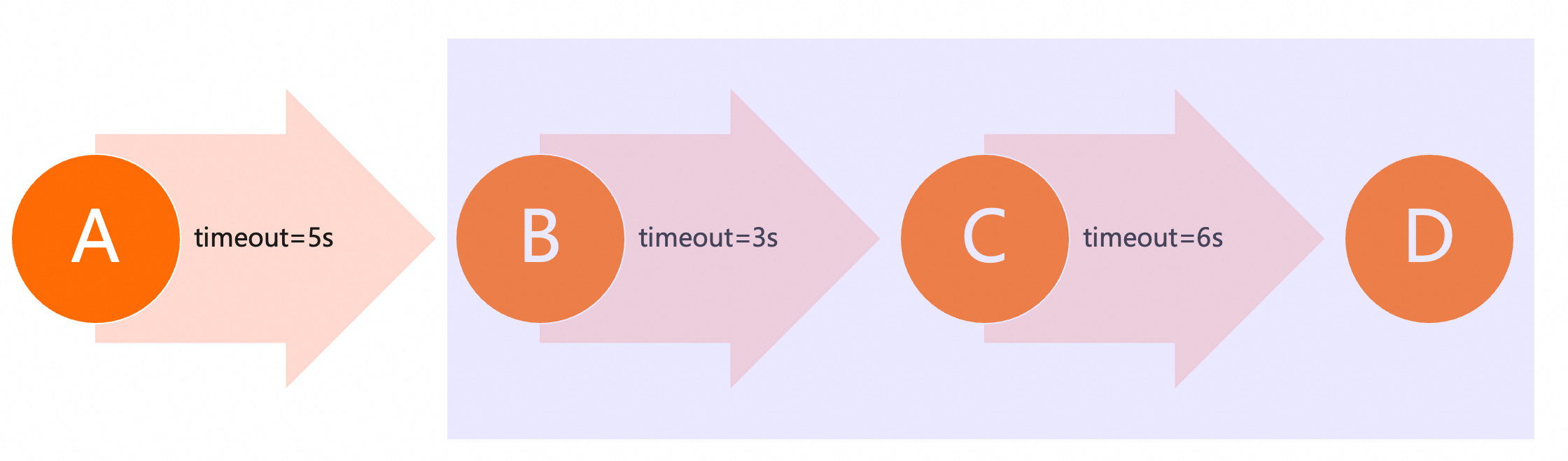
Let’s analyze the above calling chain and the possible timeout situations:
- A calls B and sets a timeout of 5 seconds, therefore the total time for
B -> C -> Dshould not exceed 5 seconds, otherwise A will receive a timeout exception. - Theoretically, both
B -> CandC -> Dhave their own independent timeout settings and the timeout counting is also calculated independently; they do not know whether A as the caller has timed out. - In any case, once A has waited for 5s without a response, the entire chain can be terminated. If C is still running at that point, initiating
C -> Dbecomes meaningless and wastes resources, a problem that is particularly evident in long-chain scenarios.
To address this, Dubbo introduced the Deadline mechanism. By passing a “deadline” (initially equal to the timeout) along the invocation chain, the entire process is constrained within a unified time window. As the call deepens, the deadline is continuously decremented; subsequent services use the remaining time as their effective timeout. If the deadline is exhausted, any remaining tasks in the chain are canceled.
Example:
When A initiates a call with timeout = 5000ms, the initial deadline is 5000ms.
By the time C initiates its request, if the chain has already consumed 3000ms, the call C -> D is restricted to a maximum of 2000ms.
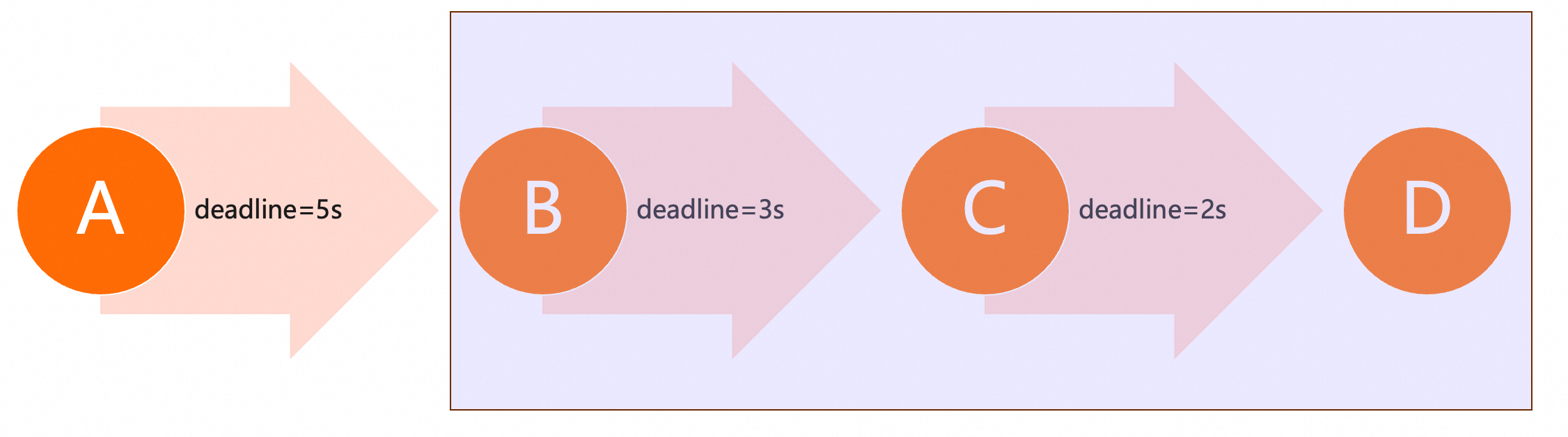
The Deadline mechanism is disabled by default and must be explicitly enabled. Use the following application-level configuration:
dubbo:
  provider:
    timeout: 5000
    parameters.enable-timeout-countdown: true
Alternatively, you can configure it for a specific service:
@DubboReference(timeout=5000, parameters={"enable-timeout-countdown", "true"})
private DemoService demoService;
In a Dubbo chain, once an upstream service enables enable-timeout-countdown=true, all subsequent nodes inherit and propagate the deadline by default (no additional configuration needed), unless a node explicitly sets it to false to break the chain. This constraint covers all synchronous and asynchronous calls initiated by Dubbo threads. However, it cannot be automatically propagated by non-Dubbo threads (e.g., custom thread pools, CompletableFuture.supplyAsync),example:
CompletableFuture<String> future = CompletableFuture.supplyAsync(() -> {
    return service.invoke("hello");
});